Nobody Signed This Contract. Everybody's Renegotiating It.
The unwritten agreement about what employers and employees owe each other is being rewritten one AI decision at a time.
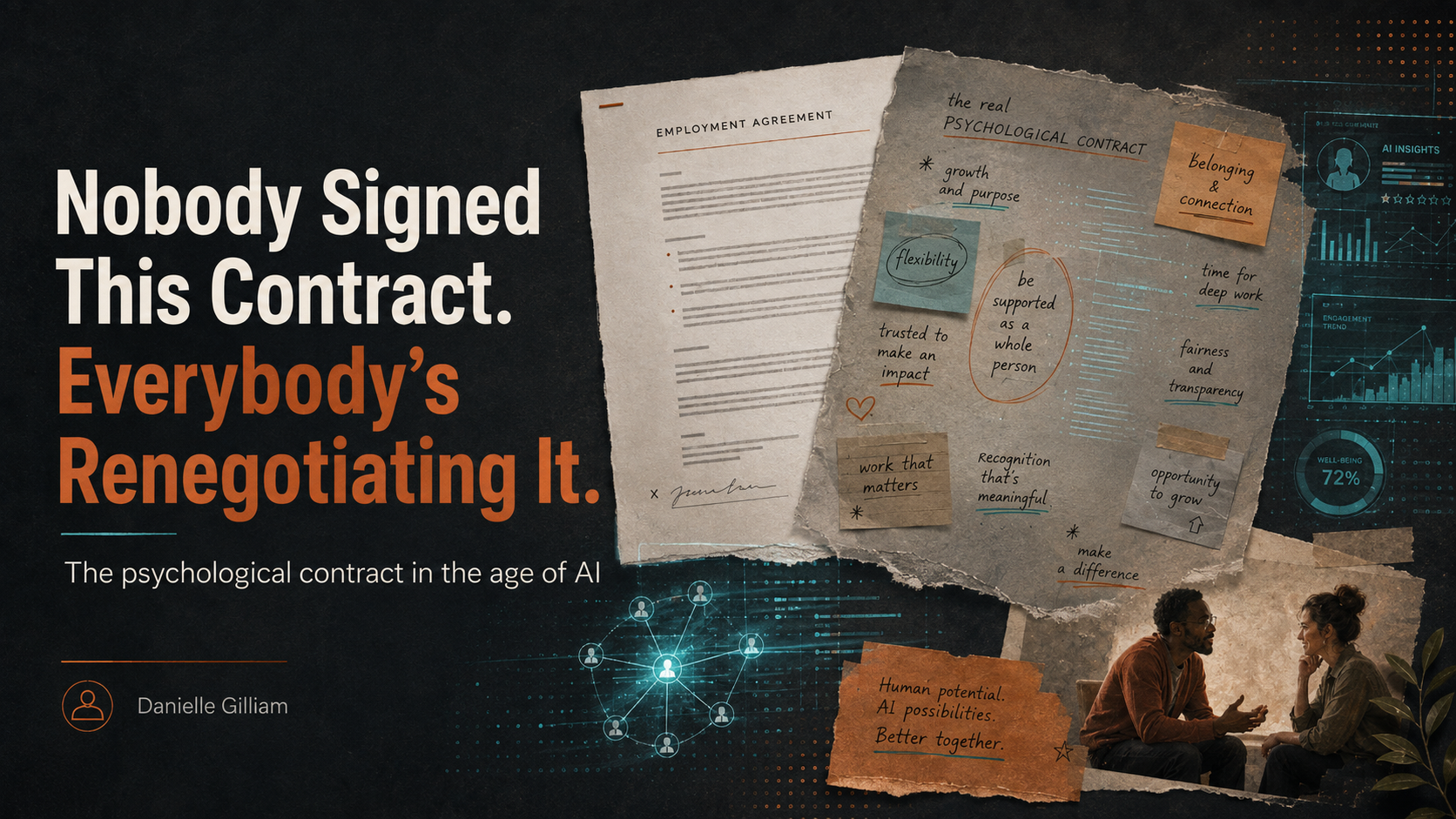
Danielle Gilliam, article image on the psychological contract in the age of AI.
For optimized experience, read on Substack: https://daniellegilliam.substack.com/p/nobody-signed-this-contract-everybodys
A few weeks ago, I found myself having the same conversation with several friends. They all worked for different organizations. They had different jobs, different managers, and different experiences.
Yet they all voiced the same disappointment. Their performance review had clearly been written by AI.
Interestingly, none of them objected to their manager using AI. In fact, most thought AI could help organize thoughts, improve writing, or summarize accomplishments more effectively than many managers could on their own.
That wasn’t the problem. The disappointment came from something much deeper.
Their managers had seemingly accepted the AI draft as the final product. The review meetings felt rushed. There was little discussion about accomplishments, almost no thoughtful coaching, and few meaningful conversations about future growth. The experience left them with an uncomfortable conclusion:
“I’m not sure my manager actually knows my work.”
That comment lingered with me. Underneath it sits an assumption most of us share: a tool can help with the words, but a person has to do the knowing.
Workers say they hold that line themselves. In Microsoft’s 2026 Work Trend Index, 86% of AI users reported treating AI output as a starting point rather than a final answer, and staying responsible for the thinking. My friends’ managers would probably say the same thing. What they skipped was everything that comes after the draft.
So the technology hadn’t failed. The relationship had.
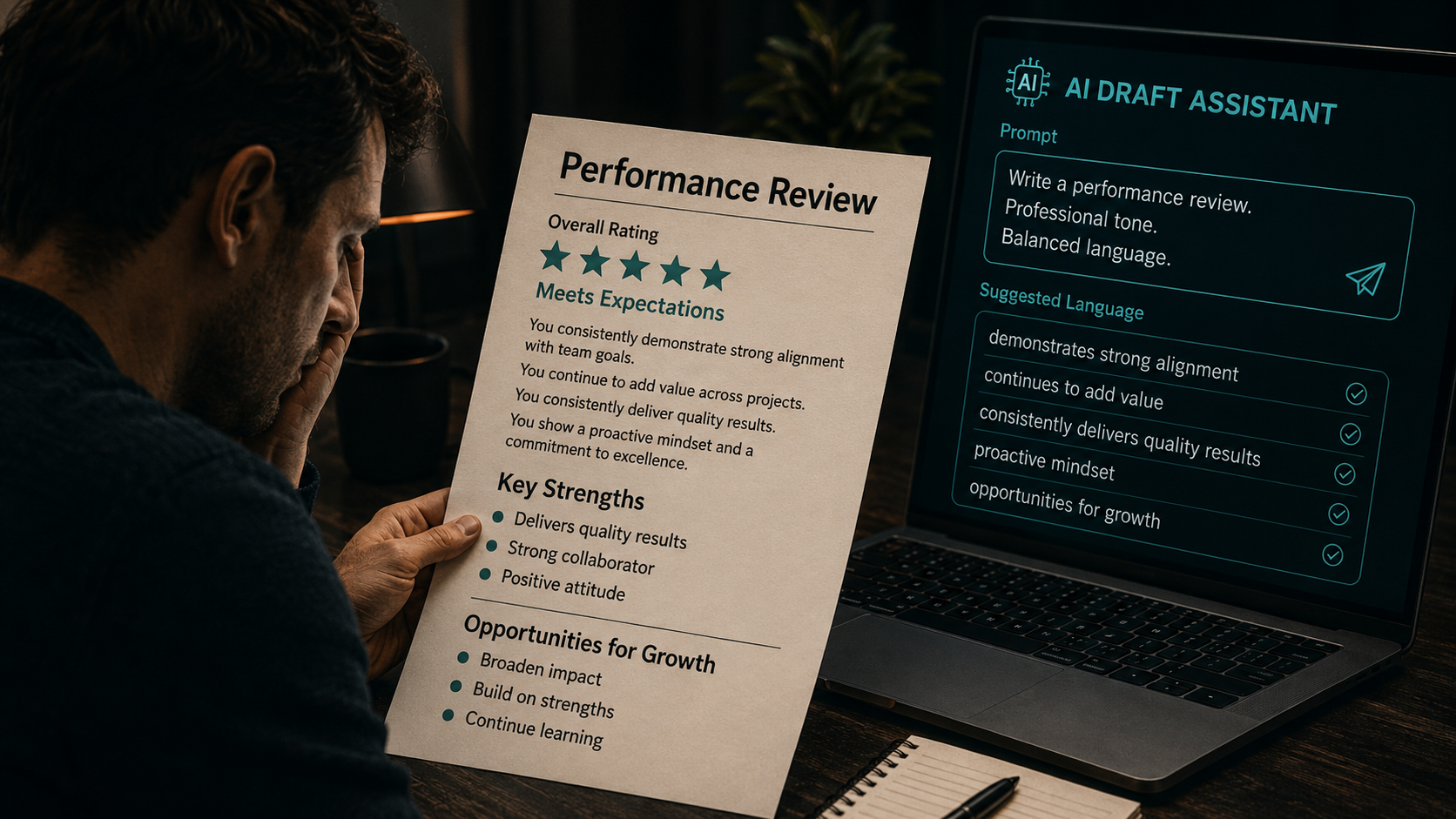
Danielle Gilliam, article image of an AI generated performance review.
The Deal You Never Signed
Organizational psychologists have had a name for that relationship for decades. They call it the psychological contract: the unwritten set of mutual expectations between employees and employers.
Unlike an employment contract, it isn’t about salary, vacation, or benefits. It’s about reciprocity.
Employees believe that if they contribute effort, commitment, and loyalty, their organization will respond with fairness, recognition, support, and opportunities to grow.
Employers, in turn, expect engagement, adaptability, initiative, and good faith from their employees.
The concept has deep roots in organizational research. Chris Argyris coined the term in 1960, and Levinson and Schein built on it through the decade that followed. But the modern research literature begins with Denise Rousseau, who re-conceptualized the idea in 1989 as an individual’s beliefs about the terms of a reciprocal exchange, then expanded it in her 1995 book Psychological Contracts in Organizations.
The premise is deceptively simple: people are motivated not only by what is written into a job description, but also by what they believe they were promised.
Trust Doesn’t Work the Same for Everyone
Artificial intelligence hasn’t changed that principle. But it is changing the environment in which those expectations are formed.
There’s early evidence of that in the research. A 2025 study of service-industry employees once again verified the key link between an employer keeping its promises and an employee trusting them. What was interesting in the data is that the trust was weaker among the workers who had most fully embraced AI. Nobody can say why yet. But it shows us that trust at work no longer appears to operate the same way for everyone.
It Isn’t the Technology
It would be tempting to read that as AI rewriting the contract on its own. The evidence points somewhere else.
That same Microsoft study, self-reported and published by a company that sells AI software, asked a more basic question: when AI genuinely improves someone’s work, what actually explains it? The answer wasn’t the technology, which everyone in the study had access to. It wasn’t the individual either. How confident a worker felt with AI, how enthusiastic they were about it, how willing to experiment: all of that mattered far less than expected.
What explained it was the environment around them. Whether their workplace made it safe to try new things. Whether their manager supported them. Whether the organization built AI into how people were evaluated and developed. Those conditions carried more than twice the weight of anything about the worker themselves.
A companion study of 1,800 employees narrowed it further, to managers specifically. When a manager used AI openly in their own work rather than simply telling their team to use it, their employees reported getting more out of it and thinking more carefully about how they used it.
So the contract is being rewritten. Just not by the technology.
Leaders are rewriting it through the choices they make about AI.
Technology doesn’t decide whether a performance review becomes an authentic coaching conversation or a transactional exercise. Managers do.
Technology doesn’t determine whether AI frees up time for deeper conversations or replaces them entirely. Leaders do.
Technology doesn’t decide whether employees feel seen, valued, or understood. People do.
Expectations Are Forming Anyway
This is where I believe many organizations risk missing the real challenge of AI adoption. Executive discussions often focus on productivity, automation, cost reduction, and efficiency. Those are important conversations, but they overlook another question that may prove just as consequential:
What new expectations are we creating without realizing it?
Employees are already forming new assumptions. If AI can eliminate repetitive work, perhaps they expect managers to spend more time coaching, not less. If AI can summarize projects and prepare documentation, perhaps they expect richer career conversations because administrative work has been reduced. Ironically, the very technology designed to create capacity may increase expectations for human leadership.
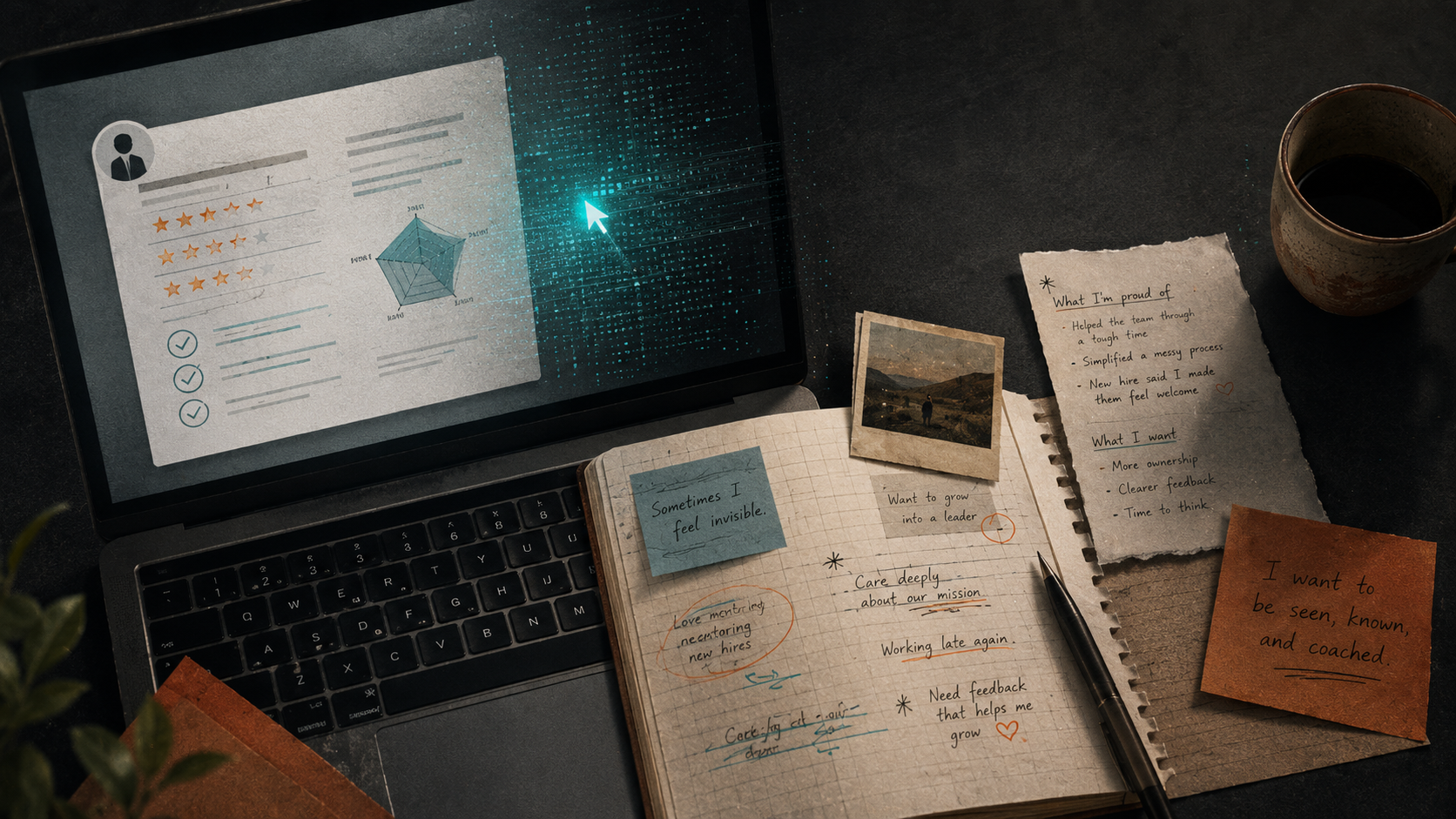
Danielle Gilliam, article image of employee expectations of a performance review.
Organizations, meanwhile, are forming expectations of their own. AI fluency, faster decision-making, greater productivity, and continuous learning are increasingly viewed as baseline expectations rather than competitive advantages.
Nobody Is Saying Any of It Out Loud
None of these expectations are typically written into an employment contract. Yet all of them become part of the psychological contract.
And almost nobody is saying them out loud. Only about one in four AI users in the Microsoft study said their organization’s leadership was clearly and consistently aligned on AI. That leaves a great deal of room for expectations to form in the absence of anyone stating them.
Perhaps the greatest risk isn’t artificial intelligence itself. It’s silent expectation drift.
When expectations change without being acknowledged, employees and organizations begin operating from different assumptions about what they owe one another. Trust rarely disappears overnight. It slowly erodes through hundreds of interactions that feel just a little less personal, a little less thoughtful, and a little less reciprocal than they once did.
We have some sense of what that erosion sounds like from the inside. Researchers at the University of Johannesburg analyzed 1,454 comments from a Reddit discussion thread about AI-driven job displacement, and sorted the recurring themes. Corporate betrayal. Identity erosion. Devalued expertise. Cynical adaptation.
That’s a self-selected group describing a difficult experience, not a measure of how widespread any of it is. But the vocabulary is worth noticing.
None of those words are about technology. They are all about the relationship.
What Has to Stay Human
The organizations that thrive in the age of AI won’t necessarily be those that automate the fastest. They will be the ones that are most intentional about protecting the parts of work that employees still expect to be unmistakably human.
Because AI may help write a performance review. But only a leader can make an employee feel genuinely understood.
Related Reading
What happens when AI doesn’t just change work, but changes what humans expect from one another?
That’s the question I explore in my companion article: Daft Punk: Humans Pretending to be Robots. AI: Robots Learning to Perform as Humans
