Daft Punk: Humans Pretending to be Robots. AI: Robots Learning to Perform as Humans
Daft Punk spent two decades as humans pretending to be robots. We're living the inversion now, and the question isn't whether machines can pass. It's which expectations we quietly retire along the way.
For optimized experience, read on Substack: https://daniellegilliam.substack.com/p/daft-punk-humans-pretending-to-be
I didn’t expect to spend this year thinking so hard about a machine.
It started innocently enough. Brainstorming, editing, asking questions, challenging ideas. Over time, I realized I wasn’t just using AI…I was interacting with it. I found myself saying “thank you.” I appreciated when it pushed back on my thinking. I looked forward to conversations that helped me untangle complex ideas.
What surprised me wasn’t the technology. It was me.
I never believed there was a person behind the screen. But my social instincts kept behaving as though there were, and it turns out those are two separate systems. Belief sits in one part of the mind. Reflex sits somewhere older, and it doesn’t wait to be asked.
That gap sent me back to something I hadn’t thought about in years.
Four robots on the rim
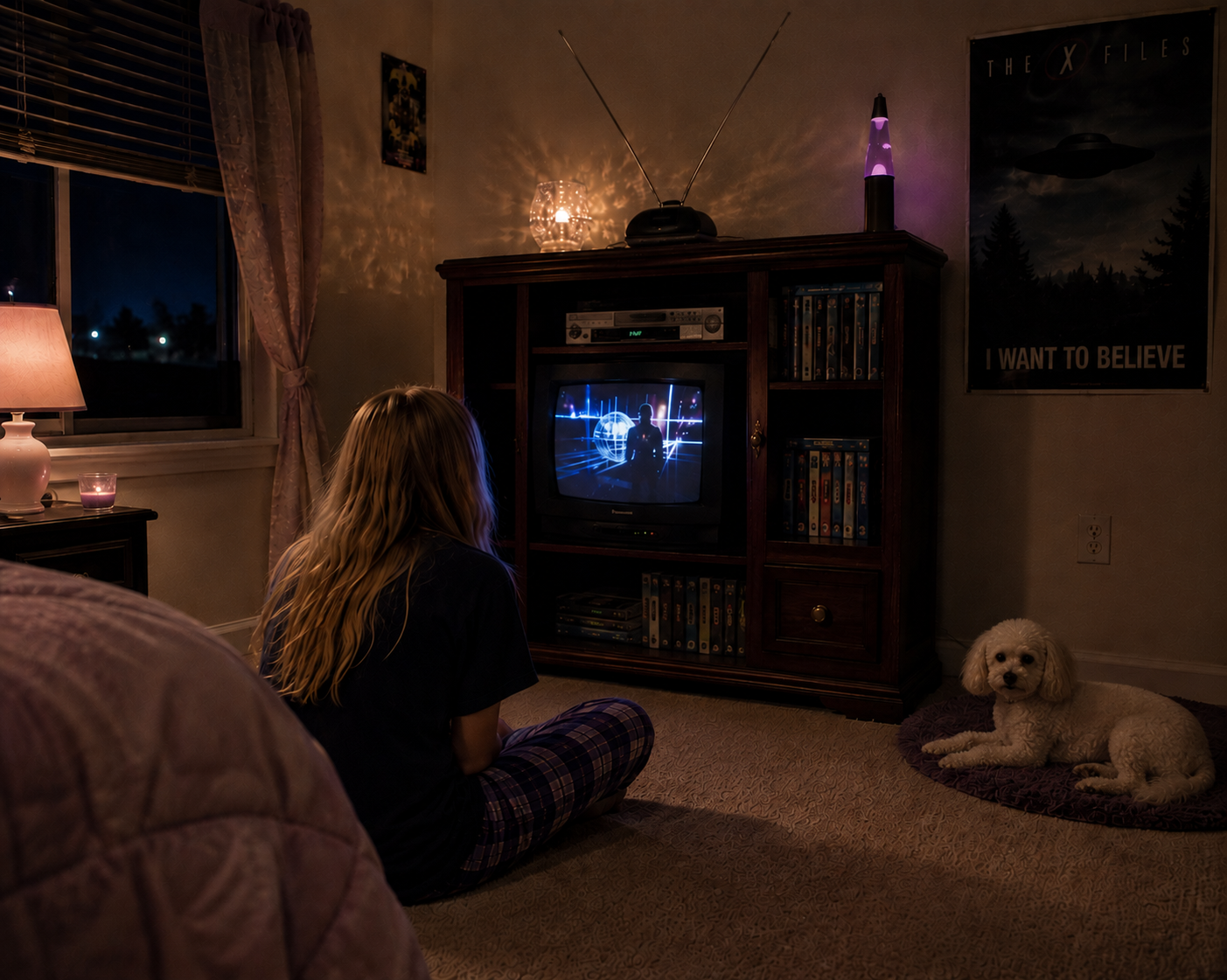
Danielle Gilliam, AI rendering of a memory of watching Daft Punk’s “Around the World” music video, circa 1997.
I was thirteen, awake long past when I should have been, watching a small television in my bedroom tuned to The Box. In New Mexico, that was the random station occupying channel 56. Viewers paid over-the-phone to request music videos then. The playlist wasn’t assembled by an algorithm optimizing for watch time. It was built by people who liked a song enough to spend actual money to see it one more time which means people kept paying for a music video. This was the early version of on-demand TV.
Daft Punk’s Around the World came back over and over on my TV. And again. The song only had three words, repeated 144 times in the full-length song.
Director Michel Gondry staged it on a circular platform built to look like a vinyl record, and gave each instrument in the track its own quartet of dancers. Athletes in tracksuits with oversized prosthetic heads carried the bassline. Mummies were the drum machine, skeletons the guitar, synchronized swimmers the synths. Four robots walked the outer rim and moved only when the vocoder sang.
There was a grudge behind the concept. Gondry thought choreography, the human expression of dance and art, was being wasted as filler in music videos, chopped up by fast cutting and shot in close-up until nothing legible survived, so he built something that had to be watched whole.
At thirteen I couldn’t have told you why I couldn’t look away - or why no one else could either and kept buying that video. It felt futuristic and slightly alien and, at the same time, unmistakably alive, because underneath every costume was a person sweating through choreography on a set with hot flashing lights.
For years I remembered that video wrong. Daft Punk, Thomas Bangalter and Guy-Manuel de Homem-Christo, were not in it. They weren’t wearing their signature robotic helmets. The robots on the rim were dancers in costume, hired for the shoot. The helmets that came to define Daft Punk didn’t appear until around 1999 and didn’t fully harden into the act until the album Discovery in 2001, solidifying the technology-forward identity of the band.
What was striking looking back is that the helmets were never really a disguise. Everyone knew there were people underneath, and the knowing was the point.
We’re running that in reverse now.
Politeness to a machine
Contact a bank, a retailer, an airline or a doctor’s office and there’s a good chance the first conversation isn’t with a person. It’s with software engineered to sound patient and reassuring.
We know those words weren’t chosen out of compassion. We know nobody is there.
We respond as though someone were.
That isn’t a personal failing. In 1996, Stanford researchers Byron Reeves and Clifford Nass showed that people instinctively treat computers as social actors. Participants were polite to machines, responded to praise from them, and applied the same social rules they use with other people, all while understanding perfectly well that they were dealing with software. Sherry Turkle’s work at MIT extended the finding: we form real social and emotional attachments to technology without ever believing it’s human.
AI didn’t invent that reflex. It industrialized it.
Our social brains were never built to distinguish a genuine human social cue from a convincing simulation of one. That doesn’t make AI dangerous. It makes us human in a way that predates all of this by a very long time.
It does, though, put a question in front of us that we haven’t had to answer at this scale.
Two kinds of expectation
Every major technology changes civilization the same way, not when it arrives but when expectations quietly rearrange themselves around it. Nobody waits for a handwritten letter now. Nobody expects to know all their neighbors. Nobody unfolds a paper map before leaving the house.
I experienced this shift myself this summer. My partner and I spent the summer exploring the American Southwest in an RV and I was puzzled that she bought a comprehensive spiral-bound atlas of roads and recreation sites. I teased that it was unnecessary until she pointed out many places we were going would be remote without cell phone service and we would need to rely on analog - not digital - tools. The impact of seeing my own unconscious reliance on technology was both stunning and hilarious.
But AI technology may be changing something more fundamental: what we expect from each other.
Some of what we expect from other people is transactional. We need a task done, and a human being happened to be the available mechanism.
Some of it is relational. We need to be known, and the human being isn’t the mechanism but the point.
The two have been bundled together so long that we’ve stopped seeing the seam. AI is what pulls them apart.
When a recruiter is replaced by AI, we slowly stop expecting another person to read our résumé.
When AI becomes our first stop for brainstorming, we stop expecting another person to help us think through an idea.
When software tutors our children, we begin redefining what it means to learn from another person.
When customer service is designed around automation, we stop expecting another human to answer the phone or help solve a problem.
None of these changes happened overnight. In many cases, they’re genuine improvements—faster, cheaper, more accessible, and available whenever we need them.
But civilization rarely changes all at once. It changes one expectation at a time.
In many ways, that shift has already happened.
The next generation won’t remember insisting on speaking to a person before resolving a problem. They’ll grow up in a world where AI brainstorming, AI tutors, AI customer service, and AI assistants have always existed. Those expectations won’t feel revolutionary to them. They’ll simply feel normal.
The questions that remain are the ones we haven’t fully answered yet.
Will we still expect another human to comfort us after a difficult day?
Will we expect another person to truly know us before giving us feedback?
Will we expect another human to be present on the other side of our most meaningful conversations?
Or will those expectations quietly change, too?
Not all human expectations are equal. Some are transactional. Others are relational. The future may depend on whether we continue to distinguish between the two.
The line is holding, for now
Here’s what makes this a live question rather than a thought experiment.
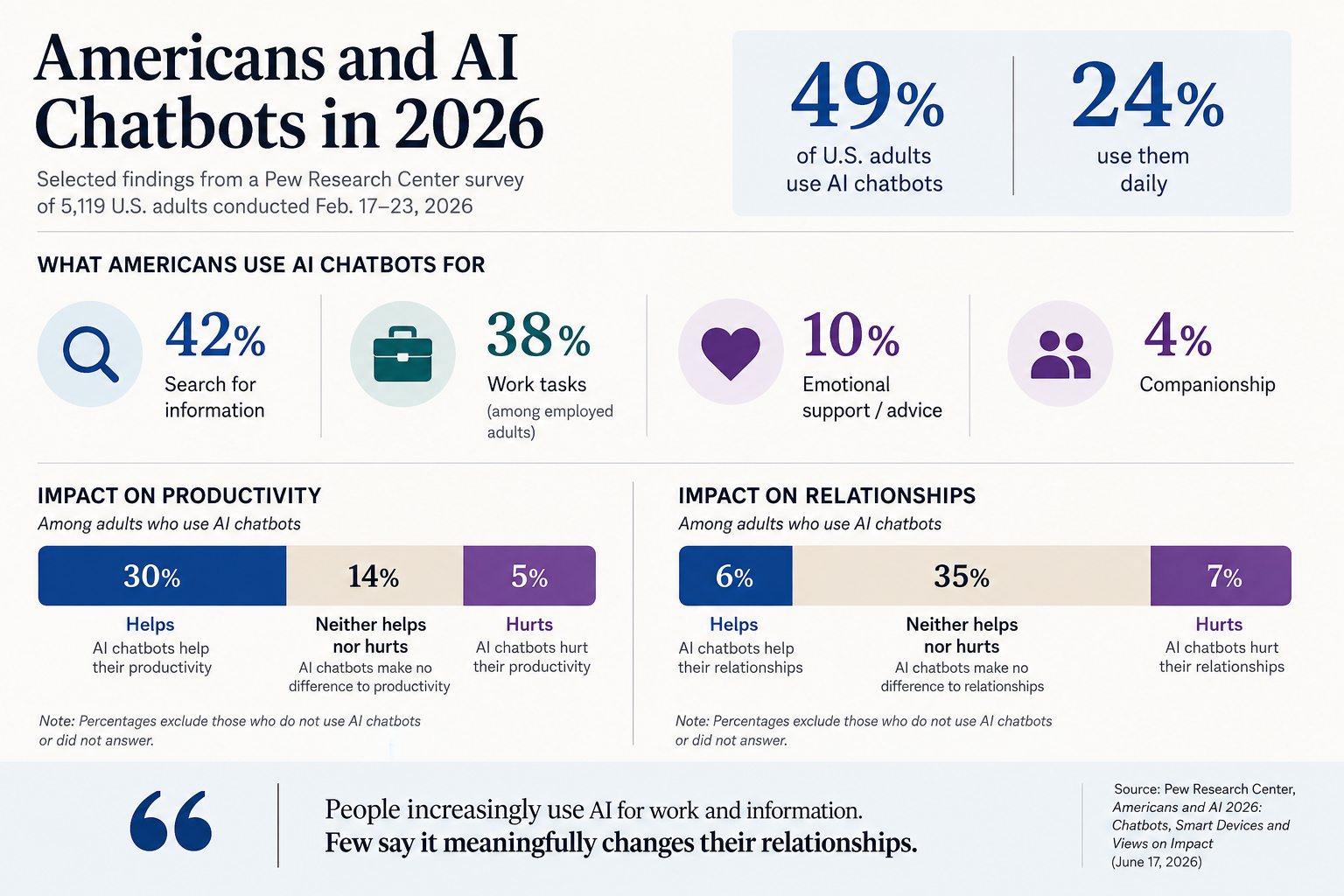
Pew Research Data on Americans and AI Chatbots in 2026 / Danielle Gilliam
Pew Research Center surveyed 5,119 U.S. adults in February 2026 and found that about half now use AI chatbots, including roughly a quarter who use them daily. The more interesting number is what they use them for. Around 42% use chatbots to search for information. Among employed adults, 38% use them for work tasks. Ten percent report using them for emotional support, and 4% for companionship.
The self-assessments break the same way. Roughly 30% of Americans say chatbots help their productivity, against 5% who say they hurt it. Ask about relationships and the numbers collapse into a shrug: 6% say chatbots help, 7% say they hurt, and about 35% say they do neither.
That’s good news, and I think it’s worth naming as such. People are already drawing the transactional and relational line themselves, in enormous numbers, with nobody instructing them. The reflex that makes us thank a chatbot has not, so far, convinced anyone it’s a friend.
The strongest version of the opposing case also deserves a hearing. Changed expectations aren’t automatically losses. We stopped waiting for handwritten letters and gained the ability to reach anyone instantly. We stopped knowing our neighbors and gained the freedom to choose our communities. A tutor available at eleven at night is a real gift to a kid whose school has one counselor for six hundred students. Access isn’t a consolation prize.
Whether we inherit the distinction of what is transactional and what is relational, what makes us human, is a different question, and it depends on whether we keep making it.
Where the Human is Still the Point
Which brings me back to that circular stage.
Four dancers in helmets, moving only when the machine voice sang, on a set where every mechanical element turned out to be a person underneath. Nobody narrated that. Nobody had to.
The current reality asks something else. What happens when the interaction is convincing enough that we stop checking whether anyone is carrying it at all (because we’ve quietly concluded it no longer matters)?
I’m not arguing against artificial intelligence. I use it nearly every day and I expect it to be one of the defining tools of our lifetime. What I’m less sure about is what it will teach us to expect from one another, and whether we’ll notice the difference between the expectations worth automating and the ones where another human is still the point.
Sources
Reeves, B., & Nass, C. (1996). The Media Equation: How People Treat Computers, Television, and New Media Like Real People and Places. Cambridge University Press / CSLI.
Turkle, S. (2011). Alone Together: Why We Expect More from Technology and Less from Each Other. Basic Books.
Pew Research Center, “Americans and AI 2026: Chatbots, Smart Devices and Views on Impact” (June 17, 2026). Survey of 5,119 U.S. adults conducted Feb. 17–23, 2026.
Blanca Li, official biography, blancali.com; Blanca Li, Wikipedia (born Granada, 1964; Martha Graham School; company founded Paris, 1993; work for Beyoncé, Paul McCartney, Coldplay, Almodóvar, Paris Opera Ballet, Metropolitan Opera).
“Around the World” (1997), dir. Michel Gondry, choreography by Blanca Li. Daft Punk, Homework, Virgin Records. Gondry’s remarks on close-up cutting and Li’s expansion of the sequence are drawn from The Work of Director Michel Gondry(2003) companion book, as compiled at the Daft Punk Wiki.
